

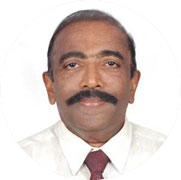
Mammen M.Oommen traces with characteristic humour
the personalities and events during his years in REC.
It was a day in June 1965, during the first few days of my life in REC Calicut. The time was about 10.30 in the night. Place: The ‘B’ hostel (What later became ‘C’ Hostel). I was one of the few unsuspecting first year students who opted to stay at the hostel instead of going back home, and spend about a week’s time that was remaining between the day of joining the college and the starting of classes, without realising what was waiting in store for us. I was busy sweeping and cleaning the alleyway on first floor, with a group of hungry second year ‘sirs’ around me giving instructions, directions, shooting questions, rebuking for not doing the work properly etc … all at the same time. Suddenly I heard a shout from somewhere and somebody crying out something, which was not legible to me. Next thing I realized was that all the ‘sirs’ have vanished in to thin air. I found myself standing there alone holding the broom and a huge figure stood in front of me staring straight through me. He ordered me out of the building and made me scram. I realised later that the temporary relief to my day’s ordeal was brought about by a ‘genuine sir’ who was the warden, and he was known as Mr. (Later Prof) P.M.Jussey. Another first year student like me was instructed to answer only “I don’t know, You don’t know, He knows” to whatever question put to him. On a similar circumstance as mine, Mr. Jussey found him. Mr. Jussey asked him what he was doing. Pat came the reply “I don’t know, you don’t know, He knows” Mr. Jussey got confused and asked him again. He got the same answer. He then asked his name. Still he got the same answer – “I don’t know, You don’t know, He knows” Mr. Jussey became really angry this time.
We were students of the last batch of Five Year Integrated course, and the fifth batch at the REC. The first batch [1961-66] of the college was in their final year when we joined. Girl students were introduced to REC through our batch (1965-70). The first girl student to join the college was Ramani K. Raja. The other girls in the batch were K. Radhamani, P.V.Vijayam, Gigi Varghese and Padmini. Gigi Varghese however left the college after first year, and continued her studies at the Govt Engineering College Trichur from the next academic year onwards. Only three of the girls passed out in 1970 and one passed out next year. We had an elaborate curriculum of English spanning the first two years. Dr Mrs. Padmini Nair was the HOD English, and Mr. P.M.Jussey was one among the other three English teachers. Dr Padmini Nair was also the warden for the only five girl students in the college hostel. Hostel was nothing but a block in the Teaching Staff quarters, with warden living in an adjacent one. Dr Padmini Nair was more than just a teacher for us. She was in fact a mother figure for all her students, especially for those feeling ‘Home Sick’. The only other lady teaching staff was Miss Valsala Devi of the Physics department. She however left the college subsequent to her marriage in 67-68. There was no English as a subject of study for Four year course. Since the importance of English in the Engineering course was lost, Dr Padmini Nair left the College on the close of academic year 1965-66 to take up her new assignment as the HOD English at Govt. Victoria College Palghat from the next academic year onwards. We gave her a befitting farewell.
REC was young and became full-fledged with all classes from first to fifth (final) year running, only when our batch joined it. Most of the first year students were accommodated in the ‘H’ Type quarters built for ministerial staff and located on the right side of the road leading to ‘Kettangal’. A few lucky ones were in A Hostel. Our seniors had rechristened ‘Kettangal’, and it was known as “Katanga” – of the Democratic Republic of Congo – during our period. There were only two hostels for habitation, Hostel ‘A’ and ‘B’ with four students living in rooms built for three. At the ‘Ministerial staff quarters’ we had no bathroom in our quarters housing three. We had an Indian style WC attached. There was one common tap (no shower) for all inmates of a block on the outside in open air to take bath, with personal security being provided by venomous snakes! If these were the conditions we had to face on the second year after the college shifted to the present campus, one can only imagine what our senior batches may have gone through at West Hill and later at Chathamangalam. The first batch was a unique assortment of students, including one who has studied over a year in Govt. Veterinary College, Trichur! There would not have been such an assortment of students in any batch ever since.
When the college shifted in 1963-64 to the present campus from the Calicut (West Hill) Polytechnic, the hall which later became ‘Heat Engines Lab’ served as living quarters for the students! By the time we joined the college, students had shifted to A and B (C) hostels and the hall was used for functions. We had our College union inauguration in the first year in that hall. Mr. K. Kamaraj, the then Chief Minister of Tamil Nadu who paid a visit to the college in the year addressed us in that hall. Prof P.M.Jussey translated Mr.K.Kamaraj’s speech from Tamil to English. That was the last function held in that hall which since had transformed in to ‘Heart Engines Lab’. Annual Day and all other functions in the following years of our stay were conducted on a permanent stage erected in front of ‘A’ hostel.
Prof. Jussey used to be associated with the activities of the arts club. One thing characteristic about Prof Jussey was his voice and diction. I still remember his reverberating voice in the background of a tableau on Omar Khayyam he presented. “Unborn tomorrow …Dead Yesterday …Why fret about them, if today be sweet …….” , as the spot light shifted from a small sweet child holding a lotus bud, to the skinny figure of a dead old man lying on a heap of hay and to Omar Khayyam and a beautiful young woman. Omar Khayyam holding a wine glass, and the beautiful young woman pouring wine out of a ‘Stainless Steel water mug’ borrowed from the mess! The sweet little girl was the daughter of Dr Lonappan, (HOD Physics). The ‘dead yesterday’ was symbolized by the frail figure of Mr. Thomas Zachariah (of third batch). Only bare minimum make up was required for him to be transformed to the character! Omar Khayyam was I. Raman (3rd batch) and the beautiful woman was my batch mate Mr. K.V.Narayanan Kutty.
Along with us, there were a couple of Final year students also in the H type quarters at Katanga. One was Mr. Handa, a tall and well built man spotting a ‘Bhagat Singh’ type mustache, and wearing spectacles. The other was Mr. Mangat Shankar, equally well built, and with a handsome clean shaved face. Both were form somewhere in the northern part of India and were minding their own business, without interfering in our affairs in any way. Mr. Mangat Shankar was a sportsman (He was once referred to as ‘Mangattu Sankaran’ by a sports columnist of the Malayalam daily “Mathrubhoomi”). Both had a heroic image in our minds because of their dignified detachment and the way they conducted themselves. The year was coming to a close, and the study leave was on. That was the time when a shopkeeper at Katanga, one ‘Sayu’ [I do not know if it was his official name, pet name or nickname!] who rented out Public address systems, decided that it was time for us to enjoy some good music! A month before we would have shut our eyes and tried to recapture the slim, young and beautiful figure of K.R.Vijaya as ‘Sakunthala’, when we heard the song ‘Priyathamaaa… Priyathamaaa… Pranaya lekhanam engine ezhuthanam …..’ in the melodious voice of P.Suseela, but the timing was now absolutely wrong. A few days went by, with some of us going to Sayu everyday and informing him that he was disturbing our studies. Sayu did not care! He was bent up on creating an ear for music in us. Then one day Mr. Handa stepped in. Naturally the music was getting on to his nerves also! He called out “Boys! Fall in”, and we obeyed the command. We fell in, and in formation. “March” came the next command. And we marched. The march ended at Sayu’s shop. “Pick up” was the next command. We picked up the loud speakers, amplifier, mike, records (78 rpm and 45 rpm) cable and all, and held it in our hands waiting for the next order.“About turn” and “March” were the commands that followed. The march ended at the thick deep jungles of the valley. We dumped all the stuff there and marched back. Nothing was damaged, or missing (If one could say that the whole thing was not missing!) Sayu quietly followed the route later, and recovered all his stuff without any damage or loss. Then came in the ‘Kunnamangalam’ police! Four constables lead by a pot bellied sub inspector. All the quarries of the sub inspector with our commander were in Malayalam, in his typical Malabari dialect and accent. Mr. Handa answered all, also in his broken Malayalam which he picked up during his stay in the state. “Music – that is our soul” “Malayalam film songs? – we love it” “Sayu …? Sayu who….?” “Loud speaker..? – No!… None – No one speaks loud during study holidays!” …. went on the responses. Sayu got all his stuff back intact, and we lived happily ever after without any menace! Last I heard of Mr. Handa and Mr. Mangat Shankar (that was a long ago) was that both were serving as Colonels in the Indian Army and were commanding the Indian troops!
K.Kamaraj, G.D.Naidu, Swamy Chinmayananda, Justice V.R.Krishna Iyer and some central and state ministers were among the distinguished personalities who visited the college at different times as guests and addressed us during our stay of five years. Satya Sai Baba visited our principal Dr. M.V. Kesava Rao at his residence as his guest. Satya Sai Baba was not a very widely heard of name in Kerala then. From the field of music, we were blessed to have K.J.Yesudas, and also Music Director M.S.Viswanathan with his orchestra. M.S.Viswanathan’s group consisted of singers like T.M.Soundararajan, P.B.Sreenivas, P.Suseela, L.R.Easwari, Veeramani and Pattam Sadan, among others. M.S.Viswanathan’s group came to Calicut town for a mega event. The tickets for the programme were priced rather high. His group and all the above singers performed in front of ‘A’ Hostel for us the next evening, free of charge! S.P.Balasubramaniam and P.Jayachandran who were just beginners then also performed for us on different occasions. Geetha Arts club Changanacherry once presented a Malayalam drama by name ‘Paalam Apakatathil’. An actor who handled an unimportant comedy role was a person who later excelled in the Malayalam cinema industry in character roles. His name was ‘Thilakan’.
K.J. Yesudas and Party performed for us on 06th February 1969 on the occasion of college day. The orchestra, by today’s standard or compared to what one may come across today even for the programme of any third rate local club, or for the programme of some ‘nobody’ who has just shown his face on some TV reality show, was a modest one. Main instruments consisted of one Harmonium, One Tabala, Two Guitars (one guitarist was his brother) and three violins. One violinist was our own K.P.Alexander of the third batch. A sum of Rs 3500/- was paid to Yesudas and his group for the programme. Rs 5000/- was his usual rate. My batch mates Mr. T.M.Xavier (Who was the General Secretary) and Late Mr.A.Gopakuar went to Mr.Yesudas’s house in Cochin and fixed up the programme. Yesudas said he did not want to bargain with A.Gopakuar, whose father was known to him. Thus Rs 3500/- was a discounted rate.
Activities of the Arts Club were later taken over by Mr. (Later Prof). P.K.Bharathan. P.Jayachandran has sung only three or four songs for films when he performed at REC. I am told that before going on the stage he requested Mr. P.K.Bharathan that if someone makes enquires later about his charges, they may please be told that he was paid Rs 5000/-. Bharathan sir agreed. A few minutes later he repeated the request. Mr.Bharathan again said yes. When he said the same thing for a third time Mr.Bharathan said “First you go on the stage and sing, we will tell that we paid you ten thousand!” There were only limited number of buses plying between Mukkam and town, and the bus route used to be through the campus. The Fare was 65 paise one way for going to town. Cinema tickets used to range from Rs 2 to 2.50 in town. Tuition fee was Rs 180 for a term, and mess fee was ranging from Rs85 to 95 per month (which could go up to 110 or 115 if one consumed too many omelets, banana or some such stuff at extra charges). All these expenses remained constant during all the five years. It was also not easy for parents of most of the students to meet the above expenses, because their incomes were also only in tune with the above expenses. The college campus consisting of the three hundred acres of land used to have its natural beauty and splendor, especially the valley with an adjoining deep wood virgin forest there. The forest was being utilized by the locals then for fermenting ‘wash,’- a concoction from which ‘arrack’ was distilled. The campus was full of yielding coconut trees. There were some expert coconut tree climbers in our batch who cemented our faith in the Charles Darwin’s theory of evolution and amply proved that men had in fact evolved from monkeys only. The highest ranking among the group later migrated to Canada and USA. I have no idea how they kept themselves abreast with the latest techniques and updated their knowledge in the subject.
Throughout our life in the campus spanning five years, we had absolutely no restrictions of any sort in our life style. We used to live in the hostel, pluck coconuts, go by bus to Kunnamangalam or Mukkam for second shows (Films) and walk back (or use rental bicycles for to and fro journey) or leave the hostel for home or anywhere else at our own wish for as many days as we want, or do whatever we want, with no permissions to seek from any one, or without any questions being asked by any one. No roll calls, no study time, no silent hours – No nothing. If someone wanted to sing at midnight he could do that at whatever decibel levels he wanted, with chorus provided by foxes in the valley. No officials would question. If anyone wanted to study – no problem – he could do that also. ‘Hostel Warden’ could be found only in ‘print’ purely for official purpose, or in that person’s official quarters. No such person was anywhere near any hostel. Our warden (in paper) used to be Mr. P.M.Jussey, sleeping peacefully in his quarters. Only exception to the usual arrangement was when fresh first year students were being admitted to the college. Mr. P.M.Jussey used to take rounds at night in places where fresh first year students were accommodated, to protect them from ragging. If nothing else, the rounds would have given him mental satisfaction. Whether it had any effect on the ragging as such, is debatable.
This used to be the general state in the first and second terms of any academic year. Towards the later part of the third term and once the study leave has commenced, the picture used to be entirely different. There were pin drop silence in all hostels always, and everyone would be busy with his studies. (Our old friend ‘Sayu’ had wrongly selected this time to stimulate our music sense!). Once, and only once, there was a different story. In our third year (1967-68) some people who passed out from some other Engineering Colleges in Kerala joined as junior lecturers in REC. Since the residential accommodations for them were not available, some of them were accommodated in our hostel with a label ‘Asst Warden’ attached to them. The new designation, new place, new atmosphere and rituals they were probably not used to, tempted one or two of them to take their designations seriously and they thought of enacting their new role. From the very beginning it was met with stiff opposition and culminated in a not so pleasant situation for the persons concerned. (Censor board has used their scissors here – and it is just enough to mention that there was no manhandling!). The problem was solved as soon as it was started, and also ended well. We all lived happily and peacefully, ‘as it was in the beginning, was then and ever after…’(Or at least as long as we passed out). No idea if they still had the same decoration of ‘Asst warden’ attached to them so long as they continued living in the Hostels. When someone mention ‘Warden’ in the context of REC, people like me belonging to the old generation tend to think that we two belong to two different planets. I visited the hostels in 1995 when we went to REC for our reunion in the 25th year of passing out. We were surprised to see that only the front entrances of all hostels were used and all the side entrances always remaining locked. To us it looked like Jails.
I consider myself lucky that I studied in REC in her younger days. Since the branches of study were confined only to three, the college was not over crowed, and also as a good side effect of ragging, everyone knew everybody else. The relationships and bond between the teachers and students also used to be strong. Apart from the names mentioned, we had some excellent teaches who were also very fine human beings. Dr M.V.Kesava Rao, Prof P.K.Charlu, Prof K.M.Bahavuddin, Dr Unni, Prof V.K.Damodaran, Dr K.V.Krishnaswamy, Prof P.M.Thomas, Prof A.O.Kunjipalo, Prof John, Prof P.K.Bharathan, Prof Sankaran Nair, Dr. Vincent Paul, Mr. Thomas Joseph etc to name only a few who molded our lives. One name that comes prominently to my mind among the teachers is that of Prof P.K.Bharathan, who handled Electrical Machinery to control systems from our second year through the final year and he has made the maximum contribution in transforming students like me to Electrical Engineers. Some teachers remain vivid in the mind not because they taught us any subject in our curriculum. Dr K.V.Krishnaswamy, fondly known as ‘Kallu (stone, not toddy!) Swamy’ taught Geology at the college. I was never a student in his class. It was Dr Krishnaswamy who took me in his own self driven car to a hospital at Vellimaadukunnu when I got injured in one of my adventures in the first year. He informed my parents about my condition through a personal letter, along with a descriptive sketch of my injury! I still preserve a hand written letter received from Prof K.M.Bahavuddin (then Principal) after I passed out from the college, asking me to contact him personally if anything was required from the college. When we were leaving the college there were A, B, C and E Hostels and messes A, B, C, D and E.
We used to have our share of fights also in our times; sometimes even with minor blood sheds – based on Batch, Hostel or House (sports), but nothing that left a permanent scar in our minds! (Another fight I still remember was with Medical College Calicut, following a Basket Ball match, in our first year. Both sides sustained small injuries!). But there was never ever a fight in the campus in the name of gods, or based on colour of flags of any political party. Politics never played any role in the college in our days, and was never allowed to creep in to the campus or our minds to cause any division, thanks to the good tradition followed from the first batch onwards. We never were aware what the religions of our friends were, or what their political leanings were, if at all they had any. The fact was that there wasn’t any such thing. It was with pain that we learned about certain unhappy incidents in the college, sparked off due to politics, a few years after we left the college.
When we were forming RECCAA Chennai chapter in the early nineties, Prof P.M.Jussey who was instrumental in formation of the RECCAA was invited for our first formal meeting. During the meeting he narrated for the benefit of the youngsters how he along with some enthusiastic old students of REC formed a small group at Ernakulam in the early eighties with a name ‘RECCAA’, with a goal to try to make the best treatment available in the world for a fellow old student by name Miss Suma Joseph, who was paralysed. The late Miss Suma Joseph joined the college in 1967-68.
Changes are inevitable and it will keep taking place. The institute itself has transformed with a new name. When we visited REC in 1995 for our 25th year reunion, we found a concrete jungle there in the campus, which was still in the process of growing. I have travelled extensively to different parts of the world as part of my job and made many friends in the years. But I consider the best days of my life were those I spend in REC, and most of my lasting friendships are those I made there.
“Long live RECC that is NITC!”


 LinkedIn
 Instagram
 Facebook