
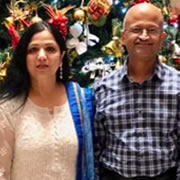
To begin with, let me thank you for taking time off your busy schedule for this interactive session with us. We would love to hear about your professional journey starting from KELTRON in 1979 to your own company, Halla Mechatronics. Could you please share the actual milestones spanning these 40 years?
Getting into REC was the first milestone in my life, as I didn’t even have a first class for pre-degree. I was the last ranked candidate for admission at REC and as I was interviewed by the Principal, Prof. Bahauddin, looking at my mark sheets he said, “you have to work much harder than the others”. Those words struck me, and I took it to my heart.
Once in REC, I had friends who literally taught me how to study. Somehow, I got first rank in the 5th semester which automatically got me the post of chairman of Electrical Engineering Association in college. That was the first stint of leadership that came my way. Even though I never thought I had any leadership quality, I had to organise many programs, arrange seminars etc. A major program I took up that year, was to arrange an internship for the students with KSEB, first time in the history of REC. Lot of students could do the internship with various power stations across the state, for which I had to travel to Trivandrum to meet the Chief Engineer of KSEB. It was Venkataramany Sir who gave me all support for this activity. My first lesson of leadership.
After graduating, I got selected to Keltron along with several others. I happened to join R&D division of Keltron. Within a year, I applied for PhD program in IIT Madras. But I ended up in MS. My professor V.V Shastry was very good and after completing MS, he advised I go abroad and do PhD. I applied to all universities from which papers were published in my area ‘power electronics’. Luckily, I could get admission and fellowship to study at University of Toronto, which was one of the best ‘power groups’ in the world. So, I learned from world’s best professors. I did one more Masters’ there, under Prof. Dewan, who was the power electronics guru and then PhD under Prof. Sleiman, who was an authority in machines. I was very lucky to have been guided by these eminent professors. I owe them quite a bit. Neodymium magnet which is used today in most of the permanent magnets was discovered just one year before that, hence my topic for research was machines and drives.
After PhD, I joined Black & Decker, who were manufacturing power tools. My wife was also doing Masters at University of Maryland in Control Systems. Together me and my wife were hired by General Motors in 1993. They had steering division which made steering systems which was of course hydraulic then. But there were people who envisioned electric power steering system and hence they hired us to work on that. By 1998, we developed electric power systems and were first to launch into market, brushless motor based electric power steering. That went on to next generation and I was working there till 2013. During this period, GM went through changes and Delphi came into existence which was later spun off as Nexteer. The same was soon bought by a Chinese company. That was when a few of us decided to move out and Halla Mechatronics came into existence. Halla is a Korean company worth more than 10 billion dollars and Mando is its automotive division. We are a sister concern to Mando. We make motor control unit for various applications.
That was history and thus I happened to be at the right place at the right time.
# Any plans to come back and work in India?
Not at present, though I would like to involve in more and more activities here. As the President of IEEE, Industrial Applications Society, I got chance to work with industries in Kerala. Kerala section of IEEE has the highest number of IEEE, IAS chapters. Hence, I’m able to interact with industries in Kerala. I see a lot of activities and growth here. I was instrumental in starting the IEEE International Conference on Transportation Electrification in collaboration with SAE(Society of Automative Engineers) India, in 2015. The intention was connecting industry with academics.
# Please elaborate on this aspect- Collaboration of academics with industry in India
It was my idea to put together SAE, India and IEEE. IEEE is known for their academics’ side and SAE for its industry connect. By this conference conducted every two years, we are able to address many local issues and local solutions, especially electrification of vehicles which is the thrust area now. This conference has been very successful in connecting industry and academics.
# How fast do you expect a change in the automobile market in India?
Indian market has its own problems when compared to other countries. The mandate by Govt says by 2030 or so, a great percentage of market should be replaced by electric vehicles. Battery power is a challenge. Infrastructure problems here to facilitate charging are much more complex than other western countries. But it’s up to us, engineers, to solve the technological hurdles.
# Any major difference you see in the quality of engineering graduates in India and US? Of late, there is a lot of negative feedback on the low employability of engineering graduates from India. Have you felt so?
I cannot generalize. Still, anybody in the US would love to hire a graduate from IITs. It is the foundation that has to be laid in undergraduate study, and no rocket science is expected out of a fresh graduate. Fundamentals are still strong in Indian curriculum. The main difference in US undergraduates is broader understanding of applications. There, students are exposed to a bigger picture and a wider perspective, with more awareness on “why am I studying this”. Our study is a bit narrow, I must say.
# Your suggestion on how NITCA as a community can help budding engineers
Mentoring programs were taken up by NITCAA US chapter and we register as mentors, available to the students back here at NITC. We provide a conduit to the older generation and required advice. We create an environment for free communication between the young and the professionals in the field. Alumni network can follow this example and encourage students to make use of this opportunity.
# The most cherished memories from REC days?
The friendships created at the campus which last a lifetime.


 LinkedIn
 Instagram
 Facebook